Eid 2026 path locked to Option A (powered Yamaha DZR12-D, Dante) — the only architecture whose components ship before the May 23-24 install window. Option B (passive 70V) amp lead times are June 2026 and is documented as a future alternative only. Live Sweetwater prices applied where confirmed; remaining lines TBC.
Prepared for Bassam & Uthman Kadry · Oakland Expo Center
A permanent sound system, built into the hall.
The venue's existing structural columns become a discreet, distributed audio system that covers every event — speech, banquet, prayer, concert — with no setup, no rentals, no floor footprint.
Study by Obai Sukar / Sugar IT · May 2026 · For Eid al-Adha, Wed May 27, 2026
TL;DR — in plain language
What you get and what it costs.
We install 48 speakers — two on each of the venue's 24 structural columns — wire them into a small equipment rack, and tune the system to the room. Once installed, any event runs from a single preset on the touchscreen. No truck rolls, no rentals, no cabling on the floor. Owned, not borrowed.
Option AEid 2026 · powered Dante · in stock
The recommended configuration is Option A — powered Yamaha DZR12-D speakers on a Dante network. This is the only architecture whose key components are confirmed in stock at Sweetwater and shipping in the May 23-24 install window: DZR12-D speakers $1,629.99 each (in stock), DXS18XLF-D subwoofers $1,924.99 (in stock), DM3-D mixer $2,194.99, Netgear M4250 Dante switch in stock. Q-SYS Core 110f price and UB-DZR brackets are still TBC. A passive 70V alternative (Option B) is documented for the record, but its central amplifiers (Crown DCi-series, QSC CX-Q) all carry June-2026 lead times — they cannot arrive before Eid. Option B is a future-install option only, not a path for May 27, 2026.
Why trust this number
Every speaker count comes from a coverage calculation, not a feeling. Equipment lines with confirmed Sweetwater prices are sourced and dated (DZR12-D, DXS18XLF-D, DM3-D, K12.2 — fetched 2026-05-19); remaining lines are marked TBC with a specific honest reason on each one. A second engineer (Manus) ran the same problem independently and reached the same architecture from first principles — see the project journey for the rigor trail.
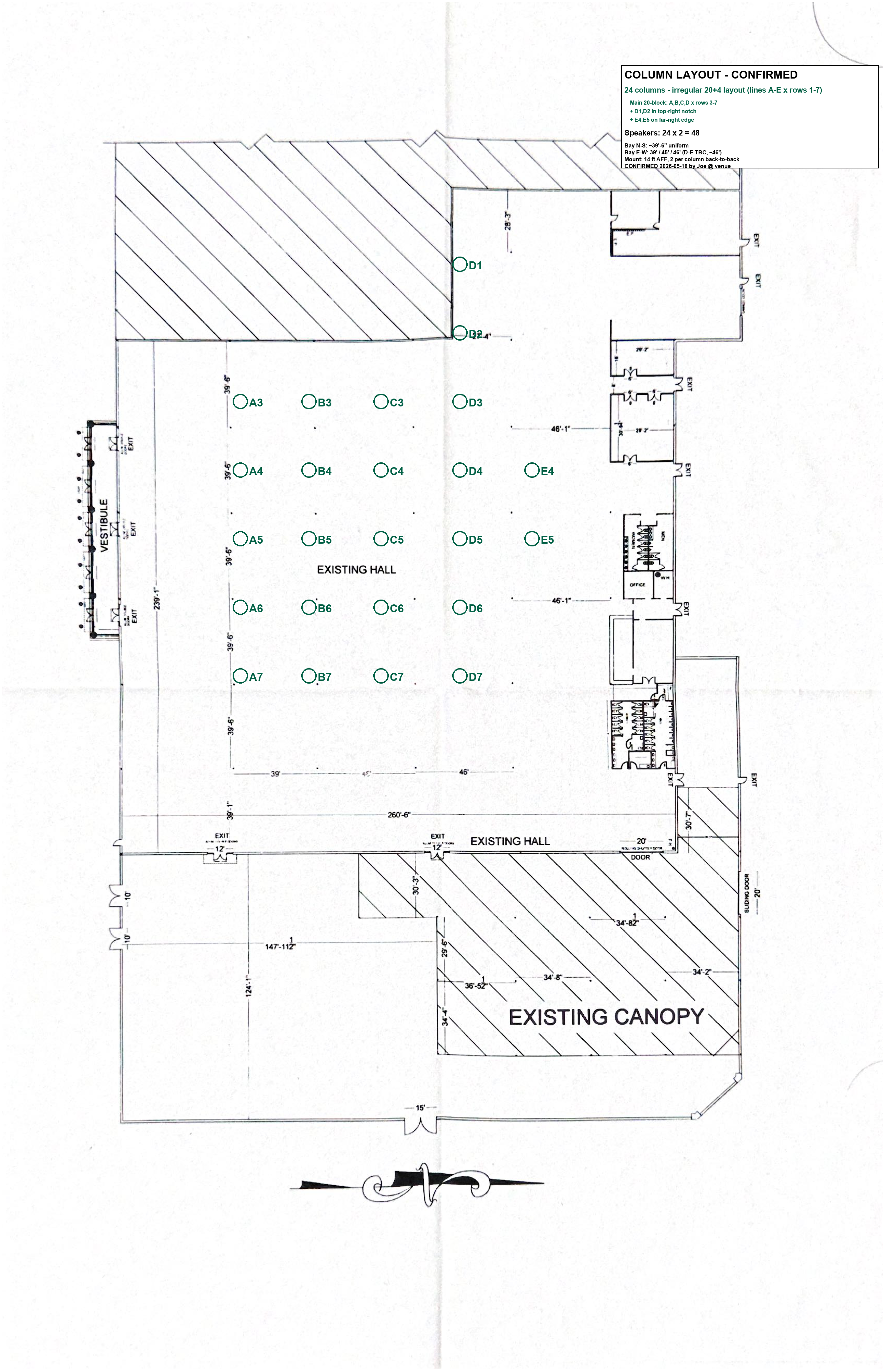
Confirmed column layout, traced on the venue's floorplan — verified on site by Joe Joe, May 18.
Section 1
The room.
Oakland Expo Center's main hall is approximately 260'-6" by 239'-1" — roughly 62,300 square feet of usable floor under a bow-truss ceiling that varies from 18 to 22 feet. The floor is engineered wood. The perimeter is pipe-and-base black drape (sound-absorbing for high frequencies only). Slender steel columns sleeved in matching drape stand on the structural grid the full length of the hall — and each column carries a pair of NEMA L6-20R (20A, 250V) locking outlets at its base. No electrical rough-in is needed.
18–22ftCeiling height rangebow-truss · reflective metal deck
Section 2
Why engineering is audible in this room.
A hall this big, with a hard ceiling and a wood floor, is loud when empty. Sound bounces back and forth long after the source has stopped — the technical name is reverberation time. In an empty Oakland Expo hall it measures around 5.83 seconds. That's long enough that the start of one word overlaps with the end of the previous one. Words run together. Speech becomes mush.
Bodies absorb sound. A typical banquet (~800 chair-seated) brings the reverb tail down to ~4.3 seconds — chair-seated audiences leave most of the wood floor exposed and reflective. Eid prayer is acoustically different and acoustically friendlier: ~2,000 worshippers seated densely on the floor, in robes/garments, effectively replace much of the hard wood floor with an absorbing layer. The occupied-Eid RT60 with this floor-seated model falls in the ~1.6–2.2 second range depending on absorption assumptions; the conservative design value is ~2.0 seconds (α = 0.60 mid-band, 90% effective floor coverage — see Appendix A for the full sensitivity matrix). The room is meaningfully kinder to speech during the prayer itself than at any other event — but only meaningfully, not dramatically. And RT60 alone does not guarantee intelligibility: delay smearing between simultaneous speakers ~40 ft apart is still ~35 ms, past the Haas threshold, regardless of how short the reverb tail gets. That's why delay zoning still matters at any occupancy.
Reverberation decay envelopes — how long it takes the room to quiet by 60 dB at three occupancy states.
The headline chart. Distributed + delay-zoned (forest green) is the only curve that stays above the usable speech-clarity threshold across the full hall. Both alternatives fail past ~80 ft.
The delay-and-echo problem at this scale
The other failure mode is delay between speakers. Sound travels about 1.13 feet per millisecond. If a speaker 80 feet farther away fires at the same moment as a near one, you hear the same word twice, ~70 ms apart. Past ~30–40 ms, the brain perceives an echo and intelligibility collapses. The fix is per-row delay zoning — each row of speakers is held back so its output arrives in sync with the natural wavefront from the stage. Without it, distributed systems in long rooms sound like a slap-back echo chamber.
A respectful comparable: ICD Center, Detroit
A high-ceiling Detroit hall ran a similar event last Eid on an under-engineered system. Coverage was uneven, long words echoed, intelligibility fell apart past the front rows. The system worked as a PA in isolation; it failed in occupancy. The lesson isn't about brand or budget — it's that speech intelligibility in a 1.2-million-cubic-foot reverberant hall is won or lost by delay zoning, distributed coverage, and per-row time alignment. That's the foundation of this design.
Engineering detail — Sabine calculation & STI threshold Engineer layer
Sabine reverberation: RT60 = 0.049 × V / A, where V = hall volume in ft³ and A = total absorption in sabins.
Absorption coefficients used: engineered wood floor α=0.07, metal deck α=0.05, light perimeter drape α=0.15 (HF-only). Total empty absorption ≈ 10,500 sabins → RT60 ≈ 5.83 s.
Banquet (~800 chair-seated): chair-seated audiences cover ~10-15% of the floor; the wood floor between chairs stays reflective. Treat as discrete absorbers on top of bare-floor model: 800 × 3.5 sabins/person = 2,800 sabins added → total 13,636 sabins → RT60 ≈ 4.48 s.
Eid prayer (~2,000 floor-seated worshippers): floor-seated prayer is acoustically different. Worshippers sit densely on the floor in robes/garments, covering most of the prayer-floor plane. The floor's acoustic behaviour shifts — the bare-wood α = 0.07 is replaced over the covered area by a crowd-covered surface coefficient.
Two inputs carry real uncertainty and both are stated honestly as ranges, not single values:
Crowd-surface absorption α. Published audience-absorption tables (Beranek; ISO 354) give a seated audience at α ≈ 0.60 (lower bound, sparse/thin clothing) to ≈ 0.80 (upper bound, dense/heavy garments). A robed floor-seated crowd sits within that range — not automatically at the top. The design uses α = 0.60 as the conservative value, with 0.70 and 0.80 shown for comparison.
Floor coverage fraction. A prayer crowd is not a fitted carpet — it scatters, leaves aisles, and absorption is not perfectly uniform across the floor plane. The headline assumes 90% of the open hall floor is effectively covered; an 80% and 75% case are shown for the more conservative reading where aisles and gaps are larger than expected.
RT60 sensitivity matrix (Sabine, V = 1,245,300 ft³):
Floor coverage
α = 0.60
α = 0.70
α = 0.80
90% (headline case)
1.98 s ← design value
1.77 s
1.59 s
80% (gaps/aisles larger)
2.14 s
1.91 s
1.73 s
75% (most conservative)
2.22 s
1.99 s
1.81 s
Headline occupied-Eid RT60 = ~2.0 s (α = 0.60, 90% coverage — conservative within the defensible range). Full range across all defensible assumption combinations: 1.6 – 2.2 s. The earlier single-value figure of ~1.59 s used the optimistic α = 0.80 corner of this matrix; the new headline uses the conservative corner. The still-earlier 3.45 s value used a discrete-absorber model that under-counted the floor-replacement effect and is superseded.
Assumption limitations stated openly: this Sabine model is a single-number reverberation estimate. Real reverberation in a crowd-occupied hall varies by frequency (HF absorbs more than LF in robes/garments), by position (front rows under the speakers behave differently from back-wall positions), and by precise crowd density. Sabine with a crowd-surface model is a defensible engineering approximation; it is not a substitute for an in-room measurement of the occupied space. The pre-Eid verification service (§16) is what closes that gap.
Implication for critical distance (conservative case): Dc = 0.141 × √(Q × A). For Q=6 in the Eid-occupied room with A ≈ 30,800 sabins, Dc rises from ~36 ft (empty) to ~61 ft (Eid-occupied, conservative) — meaningful improvement, but less than the 68 ft the optimistic case predicted. The room is friendlier under prayer occupancy than at any other event, but not as friendly as the optimistic-α case suggested.
This does NOT change the delay-zoning requirement. Simultaneous speakers ~40 ft apart still produce 35 ms relative-arrival smearing at intermediate listener positions regardless of RT60. Past the Haas zone (~20–25 ms), 35 ms reads as a distinct echo and intelligibility for continuous speech collapses unless rows are time-aligned. The delay-smearing argument does not depend on RT60 at all.
Critical distance: Dc = 0.141 × √(Q × A). For Q=6 speaker in a chair-seated banquet-occupied room (A ≈ 13,600 sabins): Dc ≈ 43 ft — the design-baseline figure used in the §7 SPL chart. In the Eid floor-seated case the room's absorption is higher and Dc rises to ~61 ft (conservative) / ~68 ft (optimistic) per the sensitivity matrix above. Beyond Dc, additional speaker SPL doesn't increase intelligibility — only direct-field coverage does. This is why distributed beats centralized in this room.
STI (Speech Transmission Index) falls below the usable 0.50 threshold past ~30–40 ms of delay smearing. On the 39.5-ft bay grid, two speakers firing simultaneously create 70+ ms smearing at distant listener positions — guaranteeing STI collapse without delay zoning.
Section 3
Why size isn't what drives the price.
Floor area is the wrong instinct to anchor on. The real driver is the difficulty class of the room: how it reflects sound, how its geometry focuses or scatters energy, and how high the intelligibility bar is set by the event program. A worship space with a focusing dome can cost more to engineer correctly than a flat-ceilinged hall many times its size — because the dome itself fights the system every second it is on.
Higher difficulty class
A focusing-dome worship space
Stone or concrete dome geometry creates focal hot-spots and standing waves no flat-deck hall encounters. Worship-grade intelligibility across thousands of attendees under that dome requires dense speaker counts, custom signal chains, and far more engineering hours than a flat-deck venue. The room itself is the adversary.
Oakland Expo's class
Flat metal-deck hall — lower difficulty
Reverberant, yes — but acoustically straightforward by comparison. No focusing geometry, no standing-wave hot spots, predictable RT60 behavior. A smaller, distributed system on the existing column grid meets the intelligibility bar at a fraction of the cost of a dome install. Cost tracks acoustic difficulty and program demand, not floor area.
Section 4
The recommended approach.
Distributed audio on the venue's existing structural columns. Two speakers per column, mounted at 14 ft above finished floor, aimed down at the audience plane. A small equipment rack at the head-end holds the amplifiers (for the passive option) or just the DSP and Dante switch (for the powered option). One DSP, configured for four stage orientations (north-end, south-end, long-wall-east, in-the-round), handles all delay zoning. Operators select the stage orientation on a touchscreen — the system reconfigures every speaker in one tap.
Permanent
Owned, not rented
Installed once. No truck rolls. No setup time. No staging or rigging crew on event days.
Discreet
Black on black
Speakers match the existing column drape. The system is invisible from across the hall.
Universal
Every event type
Speech-clear for prayer and meetings, music-capable for concerts and weddings, multi-zone for in-the-round.
Operable
One-tap recall
Stage orientation, zone routing, delays — all stored as named presets. No engineer needed on event day.
Section 5
Own vs rent — the methodology you're paying for.
A competing approach is to rent a few large speakers and a few stands per event. It is cheaper per event. It is also a recurring cost — every event, forever — and it places those large speakers on the audience floor, obstructing sightlines, requiring a crew to deploy, and tuning the room from scratch every time.
A permanent distributed system has a higher day-one cost and zero ongoing cost. It also covers every event the venue runs, not just the ones where someone remembered to order a PA in advance. The crossover (when own beats rent on lifetime cost) is typically inside the first 18 months for a venue of this size.
Lifetime cost — own (flat) vs rent (cumulative). Crossover lands inside year 2 for the stated 20-events/yr case; ~$400K saved by year 10.
The honest case for rental
If Oakland Expo Center hosts fewer than 6 events per year with PA needs, rental is mathematically cheaper. The numbers here assume a multi-use venue running 20+ events per year — which is what we've been told. We don't make this case dishonestly.
Section 6
The geometry — irregular 20+4, not a clean grid.
The hall's structural columns are not arranged in a filled rectangle. We caught this mid-engineering: an earlier placeholder of "4 × 6 = 24" would have put phantom speakers inside the off-premises hatched zone at the top-left of the floorplan. The true layout is irregular, confirmed by Joe Joe at the venue against a marked-up floorplan:
Main 20-block: lines A, B, C, D × rows 3-7 = 20 columns
+ D1, D2: line D extends two nodes north into the top-right notch where the building turns L-shaped
+ E4, E5: a short two-node line on the far-right edge
= 24 total, with Confirmed count and per-node placement.
Confirmed column layout, traced from Joe Joe's marked floorplan. The hatched zone at the top-left is off-premises and inaccessible — no speakers placed there.
E-W length axis (260 ft): 39' / 45'(*) / 46' / 46'-1" — four bays, five column-lines. A→B, C→D, D→E derived from PDF dim strings (D→E from the two "46'-1"" horizontal-arrow labels east of line D). (*) B→C smudged on the scan, 45 vs 46 ft cannot be disambiguated without an on-site remeasure or rescan — see §17. B→C TBC
Worst-case listener-to-speaker distance: 46 ft (the largest single bay on the length axis). All coverage and SPL math uses this worst case, not the average.
Why the 4×6 model was wrong Process note
An earlier draft used a clean 4×6=24 grid to position speakers on the floorplan. The grid-fill assumption silently placed speakers in the top-left hatched zone, which is off-premises (inaccessible — outside the building envelope). The catch came from re-tracing the actual structural column marks against Joe Joe's photo. The lesson is recorded in the project journey below: never give a placement tool a filled-rectangle assumption when the real layout is irregular.
Section 7
Coverage — computed, not estimated.
Coverage in a distributed system is a continuous field, with adjacent speakers' continuous SPL summing power-domain. We computed the SPL across the entire hall floor by summing every speaker's direct-field contribution, accounting for the 90°×60° beam pattern, 14 ft mount, 11.1° computed downtilt, and inverse-square distance falloff. The plan visualises the result as five zone bands — each band coloured by which delay zone's speakers dominate that strip of floor (Zone A warmest, Zone E coolest, by N-S position) — plus aim arrows on each column showing the back-to-back N/S speaker orientation.
Open the coverage plan and toggle L2 coverage for the zone bands + aim arrows, or L3 wiring for the cable runs from the head-end.
Calibrated coverage plan — scan-as-base, 24 dots placed by arithmetic transform. Toggle L2 coverage for the computed SPL heat map (~5 ft sample resolution, Mealy palette by SPL band, dashed 100 dB contour). Toggle L3 wiring for Cat6 cable runs from the central head-end.
Headline number: minimum SPL on the hall floor = 99.0 dB
The lowest computed SPL anywhere on the audience floor — including the perimeter strips with no column directly over them — is 99 dB SPL continuous. That's 19 dB above the 80 dB speech-clarity threshold and 4 dB above the 95 dB music-program target. The main grid's overlap is sufficient. No side-fill speakers are needed.
Perimeter strip analysis (computed, strip by strip)
Strip
min SPL
mean SPL
Decision
Top strip (hatched-zone south to row 3)
104.0 dB
116.4 dB
Covered by row-3 overlap. OK
West / vestibule strip (x < 5 ft from wall)
108.6 dB
118.3 dB
Covered by line A overlap. OK
Bottom strip (row 7 to south wall)
99.0 dB
113.2 dB
Covered by row 7 + 14.25 ft south margin. OK
East fringe (line E to office wall)
98.7 dB
111.6 dB
Covered by E4/E5 + D-line overlap. OK
Notch upper (above D1)
98.8 dB
110.8 dB
Covered by D1 + neighboring columns. OK
Sample resolution 3 ft for the strip analysis, 4 ft for the heat-map grid. Zero sample points across the entire hall floor fall below the 80 dB threshold.
SPL falloff for both architectures. Past Dc ≈ 43 ft (chair-seated banquet baseline; Eid floor-seated pushes Dc to ~61 ft), neither cabinet's extra SPL buys intelligibility — only distributing more cabinets does. That's why we use 48 speakers, not 8 big ones.
Why the perimeter strips clear the threshold (the math) Engineer layer
The mechanism that saves the perimeter strips is SPL summation from adjacent columns, not direct overhead coverage. For any floor point at the south wall, the four nearest speakers (line A row 7 + line B row 7 + line A row 6 + line B row 6, all within ~40 ft slant distance) each contribute around 100 dB SPL on-axis-corrected. Power-domain summation of four 100-dB sources yields ~106 dB. The 99 dB minimum at the absolute worst-case perimeter point reflects geometry where only 2-3 speakers are within Dc reach, but their summed direct-field still clears the threshold by 19 dB.
Bottom line: in a hall this size, with 48 directional speakers and a 43 ft critical distance, you get a self-overlapping coverage field. There are no “islands” — the field is continuous.
Section 8
Mounting & downtilt — a deliberate decision.
Speakers mount at 14 ft above finished floor (AFF), two per column, oriented back-to-back to cover both halves of the bay. Bay definitions used throughout this document: the typical N-S bay is 39'-6" (the uniform row spacing on the 239-ft width axis — used for delay-zoning math because every row sits on this spacing); the worst-case E-W bay is 46'-1" (the largest single bay on the 260-ft length axis — used for downtilt and far-corner SPL math because it sets the geometric extreme). At 14 ft mount, with ear height 5 ft and the worst-case half-bay of 23 ft (= 46'-1" / 2), the geometric downtilt is 11.1° below horizontal.
The choice of 14 ft is deliberate: low enough for short throws into the audience (better direct-field, less reverberant pickup), high enough to clear typical event sightlines (12-ft stage backdrops, head-tables). A lower mount (10-12 ft) would give better intelligibility but risks blocked views; a higher mount (16-20 ft) would lengthen the throw and shallow the downtilt, increasing reverberant contribution.
Cross-section: speaker at 14 ft, audience ear at 5 ft, downtilt 11° aimed at the half-bay listener.
Downtilt derivation Engineer layer
Speaker acoustic center: 14.0 ft AFF.
Audience ear height: 5.0 ft AFF.
Vertical drop: 14.0 − 5.0 = 9.0 ft.
Worst-case horizontal half-bay (46 ft / 2): 23.0 ft.
This aims the speaker's on-axis peak at the listener directly between two columns — the worst-case position. Listeners closer to either column see less off-axis loss.
Section 9
Delay zoning — the non-negotiable detail.
Each row of speakers must be delayed so its output arrives in sync with the natural wavefront from the live source on stage. On a 39'-6" bay, each successive row needs ~35 ms more delay than the row in front of it, plus a 12-ms Haas bias so listeners localize to the stage, not the nearest speaker.
The system needs seven delay zones (one per row of columns), and the DSP holds four preset scenes — one per supported stage orientation: north-end, south-end, long-wall-east, and in-the-round. Operator selects the preset; every zone retunes automatically.
Zone palette & delay ramp
A · 12 msB · 47 msC · 82 msD · 117 msE · 152 ms
Zone A is closest to the source (Haas bias only). Each subsequent zone adds the propagation delay to the next row.
Each row of column-mounted speakers waits the calculated number of milliseconds before firing, so its sound arrives in sync with the natural wavefront from the live source on stage.
Output bus & processor sizing Engineer layer
Output buses = (7 zones × 4 orientations) + 1 subwoofer + 1 canopy + 4 aux = 34 buses.
Required: open-architecture DSP with ≥34 outputs, scene memory ≥4, sub-ms-precise per-output delay.
Recommended: Q-SYS Core 110f (128 channels, mature scene system). Manus's independent review reached the same conclusion.
An ordinary mixer (e.g. Yamaha DM3-D) does not have enough output buses or per-bus delay precision for this. DSP and mixer become separate boxes: dedicated Q-SYS DSP + compact mixing surface.
Section 10
Signal path.
Microphones and program sources enter the mixer at the head-end. The mixer feeds the DSP over Dante. The DSP applies per-zone delay, EQ, and gain. Then the paths diverge:
Option A (Powered Dante): DSP → Dante network → directly to each powered speaker. No external amplifier. The amp is inside every DZR12-D cabinet.
Option B (Passive 70V): DSP → analog/AES outputs → Crown CDi 4|600 amplifier rack → 70V speaker cable → passive JBL CBT 70J-1 speakers. The amplifier is the rack, not the speaker.
Cabling from head-end to columns uses the venue's existing pathways. Dante stops at the DSP in Option B; it extends to every speaker in Option A.
Two paths, side-by-side. Top: Option A — powered Dante speakers, no external amp. Bottom: Option B — Crown amp rack drives passive speakers over 70V cable.
Section 11
Option A vs Option B — and why A is the only Eid-feasible path.
Both options are complete music-capable systems on paper. The decisive difference is availability: Sweetwater confirms Option A's powered Yamaha DZR12-D speakers and DXS18XLF-D subs are in stock and shipping now, while Option B's central amplifiers (Crown DCi-series and the QSC CX-Q alternates) all carry June 2026 lead times — they cannot reach the venue before the May 23-24 install window. Option B is documented here as a viable future install or for a non-Eid timeline; for May 27, 2026, Option A is the only path.
Three words, plain language — before the option cards
Powered means the amplifier is built inside the speaker box — plug in power and a signal, it makes sound on its own.
Passive means the speaker has no amplifier — it needs a separate amplifier (in our case, the Crown rack) wired to it to make sound.
Dante is the audio network protocol — how the signal travels over Cat6 cable. Dante is not amplification; it's a transport. Both options use Dante between the mixer and the DSP. Only Option A extends Dante all the way to the speakers.
Option A · Powered + Dante · Headline
Self-amplified speakers, audio-over-IP all the way
48× Yamaha DZR12-D powered 2-way speakers (amp built into each cabinet), 6× DXS18XLF-D powered Dante subs, Q-SYS Core 110f DSP, Netgear M4250 Dante switch, Yamaha DM3-D mixer.
One Cat6 cable per column carries audio + control (Dante)
Confirmed in stock at Sweetwater for May install — DZR12-D $1,629.99, DXS18XLF-D $1,924.99, DM3-D $2,194.99
No external amplifier rack — every speaker amplifies itself
Dante reaches every speaker — easy to expand later
Lead times: Available for Eid 2026 · Headline
Option B · Passive 70V · Future install only
External amplifier rack drives passive column speakers over 70V
48× JBL CBT 70J-1 passive column arrays (no amp inside; need to be driven externally), 4× Crown CDi DriveCore 4|600 amplifier units in a central rack, 6× JBL PRX918XLF powered subs (subs always carry their own amp — industry standard), Q-SYS Core 110f DSP, Yamaha DM3-D mixer.
Lower per-speaker cost in theory
External amplifier rack required — and these amps are the gating problem
70V daisy-chain speaker cable, not Dante (Dante in this option only between mixer and DSP)
Asymmetric J-pattern throws energy toward far rows
Not available for Eid 2026. Crown DCi-series and QSC CX-Q amplifier lead times are June 2026 — they will not arrive before the May 23-24 install window. Viable for a future install or if the timeline allows; not a path for the Eid May 27 event.
Both options are legitimate engineering for this room; Option A is recommended and is the only path available for Eid 2026.
Section 12 · Pricing engine
The numbers — full breakdown.
Confirmed Sweetwater prices for the four mass-produced retail items — Yamaha DZR12-D, DXS18XLF-D, DM3-D, QSC K12.2 — are injected below (fetch date 2026-05-19, from Obai's account). Three retail-blocked items stay TBC with specific reasons, not a blank field:
Q-SYS Core 110f (DSP) — not sold on Sweetwater's retail store; commercial-install gear routed through Sweetwater Integration. A formal quote is required, so no retail list price exists.
Yamaha UB-DZR12-series bracket — Sweetwater returned no direct results for "UB-DZR12V"; the part shown by their search (UB-DXRDHR12) is for the older DXR12 and may not fit the DZR12-D. The correct DZR12 bracket must be confirmed with Sweetwater.
Netgear M4250 switch — five variants in the lineup ($659.99–$1,479.99) differ by port count and PoE budget. The required port count is derived below from the actual Dante device list, and the recommended model + qty is set; the price is held TBC until model is locked.
The Sugar IT commission line is shown explicitly at $0 (normally 5%, waived for this client). Labor and engineering lines are fixed at $5,000 each. The headline total is therefore partial — equipment subtotal of $93,784.43 confirmed plus 10 lines pending; presented honestly that way.
Option A (Powered Dante) — headline · Eid 2026 path
Item
Model
Why this qty
Qty
Unit
Line total
Powered Dante speaker
Yamaha DZR12-D
why this qty2 per column × 24 (90°×60° horn cannot cover 360°). Amp integrated in cabinet — no external amp rack needed.
48
$1,629.99
$78,239.52
Column U-bracket
Yamaha UB-DZR12-series (exact part TBC)
why this qtyOne per speaker — vertical mount on drape-sleeved column. TBC: Sweetwater returned no results for "UB-DZR12V". Correct part (UB-DZR12H or UB-DZR12V) must be confirmed; the UB-DXRDHR12 shown by search is for the older DXR12 and may not fit the DZR12-D.
48
TBC — confirm correct DZR12 bracket
TBC
Powered subwoofer
Yamaha DXS18XLF-D
why this qty6 distributed for music low-end. Dante variant for consistent network topology.
6
$1,924.99
$11,549.94
DSP processor
Q-SYS Core 110f
why this qty34 output buses (7 zones × 4 orientations + sub + canopy + aux). Drives all delay zoning and orientation presets. TBC: not sold on Sweetwater's retail store — commercial-install gear routed through Sweetwater Integration. A formal quote is required; no retail list price exists.
1
TBC — Sweetwater Integration quote required
TBC
Mixer / control
Yamaha DM3-D
why this qtyFront-of-house — 22 ch, Dante to DSP
1
$2,194.99
$2,194.99
Dante switch
Netgear M4250-series (2 units)
why this qtyPort-count math: 48 DZR12-D + 6 DXS18XLF-D + 1 DM3-D + 1 Core 110f = 56 Dante endpoints; plus 2-4 inter-switch SFP+ trunk ports and ~4 RJ45 of future-expansion headroom = ~60-port budget. Sweetwater carries 5 M4250 variants from $659.99 to $1,479.99; the largest single unit (~26 ports) is insufficient — two switches required, recommend 2× M4250-26G4XF-PoE++ trunked via SFP+ 10G fibre (52 RJ45 + 8 SFP+ combined). TBC: confirm model + price once port count is locked.
2
TBC — confirm model+price once port count is locked
TBC
Wireless mics (handheld)
Shure SLXD24/SM58
why this qtySpeech podium + roaming
4
TBC
TBC
Wireless mics (lavalier)
Shure SLXD14/85
why this qtyFor officiants / panel
2
TBC
TBC
Cat6A shielded cable
Bulk, plenum-rated
why this qtyDerived from calibrated plan: head-end at central MEN/WOMEN/OFFICE alcove ft (218.292, 205.583) — derived from PDF dim strings (midpoint of office strip × midpoint of rows 5–6), not eyeballed; see config.py. Per-column Manhattan run from head-end + 14 ft column drop + 15% slack, × 2 cables per column (one per powered speaker). Sum: 11,775 ft → round to 12,000 ft (six 2000-ft spools or twelve 1000-ft). Longest single run = 381 ft (col A3, NW corner) — flagged as >100 m, requires fibre-to-copper drop or sub-switch near A3 column. See §13 note.
12,000 ft
TBC
TBC
Rack & head-end
Middle Atlantic 12U + accessories
why this qtyDSP, Dante switch, mixer. Located in the central MEN/WOMEN/OFFICE service alcove (east-side, mid-hall) — see coverage plan.
1
TBC
TBC
Canopy speaker
QSC K12.2
why this qtyPortable PA pair for the canopy (see §14). Side-fill / event sound for Eid + future events.
2
$899.99
$1,799.98
Canopy kit accessories
QSC sub + tripod stands + 4-ch mixer
why this qtyCompletes the portable canopy kit alongside the K12.2 pair.
TOTAL — Option A (partial — 3 retail-blocked + 7 minor lines pending)
$103,784.43 + TBC
Option B (Passive 70V) — documented alternative · NOT available for Eid 2026
This BOM is here for completeness. Option B's central amplifiers (Crown DCi-series and QSC CX-Q alternatives) all carry June 2026 lead times at Sweetwater — they cannot ship before the May 23-24 install window. This option is viable for a future install, or if the timeline shifts past Eid 2026.
Item
Model
Why this qty
Qty
Unit
Line total
Passive column array
JBL CBT 70J-1
why this qty2 per column × 24 columns
48
TBC
TBC
Column mount bracket
JBL MTC-CBT-FM2
why this qtyOne per speaker
48
TBC
TBC
Powered subwoofer
JBL PRX918XLF
why this qty6 distributed (subs always carry their own amp — industry standard)
6
TBC
TBC
Multi-channel amp
Crown CDi DriveCore 4|600
why this qty4 ch × 4 spkrs/ch. Sweetwater lead time: June 2026 → NOT AVAILABLE for May install.
4
TBC
TBC
DSP processor
Q-SYS Core 110f
why this qtySame as Option A
1
TBC
TBC
Mixer + Dante switch + mics + cabling + rack
Common front end (Dante mixer↔DSP only; analog/AES out to Crown amp rack)
why this qtyMostly shared with Option A; substitutes 70V speaker cable for Cat6 to speakers
1 set
TBC
TBC
TOTAL — Option B (future install only)
TBC · not pursued for Eid 2026
Sweetwater fetch status: manual lookup 2026-05-19 confirms Option A's DZR12-D ($1,629.99 in stock), DXS18XLF-D ($1,924.99 in stock), DM3-D ($2,194.99), QSC K12.2 ($899.99 each, in stock), and Netgear M4250 switch in stock. Q-SYS Core 110f (commercial-install via Sweetwater Integration), UB-DZR brackets, and bulk-48 stock confirmation on the DZR12-D remain TBC. Option B's Crown DCi-series and QSC CX-Q amplifiers all show June 2026 lead time — confirmed and locked as a non-starter for the Eid timeline.
Pricing validity
Equipment pricing in this BOM is an estimate based on Sweetwater pricing as of 2026-05-19, not a fixed quote. Confirmed lines are tagged with the fetch date; TBC lines carry their specific reason. Prices are subject to change until a purchase order is placed. Final invoice prices may shift by ≤2%; any larger movement is re-quoted before commitment.
Payment terms (Sugar IT labor & engineering fees, $10,000 total): 50% deposit on client approval to start procurement and crew booking; balance on commissioning sign-off (the §17 acceptance block, signed after the on-site walk-test). Equipment is invoiced separately, paid upfront by the client, and ships directly from Sweetwater to the venue.
Section 13
Equipment detail — why each line.
JBL CBT 70J-1 (Option B speaker)
Passive column array, 70°×25° asymmetric J-pattern, 75 Hz–20 kHz. The asymmetric vertical pattern is purpose-built for long throws in reverberant rooms: more energy aimed at the rear of the audience compensates for the longer distance. 70V/100V tap or 8Ω direct.
Yamaha DZR12-D (Option A speaker)
2,000W self-powered 2-way, 12-inch LF, 90°×60° horn, 49 Hz–20 kHz, Dante audio-over-IP. 133 dB SPL continuous, 139 dB SPL peak @ 1 m (manufacturer spec). Class-D internal amp. Long-term reliable, deep low-end without subwoofer dependency. All coverage and SPL math in this study uses the 133 dB continuous figure (the conservative real-event number); the 139 dB peak is for instantaneous transients only.
Q-SYS Core 110f (DSP)
QSC's appliance DSP — 128×128 channels, Q-LAN audio network, mature scene-recall system, sub-millisecond per-output delay. The 34 required output buses + 4 orientation scenes (including in-the-round) fit comfortably within the 110f's capacity.
Crown CDi DriveCore 4|600 (Option B amplifier)
4-channel install amp, 600W/ch @ 4Ω, 70V/100V capable, 2U rack height. Built for permanent install — high-efficiency Class-D, redundant fan paths, BLU-link networking. Four units cover the 48 speakers + auxiliary zones.
Shure SLXD24/SM58 + SLXD14/85 (wireless mics)
Digital wireless, 64 MHz tuning bandwidth, encryption-capable. SM58 capsule for handheld speech; WL185 lavalier for lapel use. Standard kit for any worship/conference venue.
Netgear M4250-26G4XF-PoE++ (Dante switches, × 2)
AV-line managed switches, Dante-certified, QoS preconfigured for audio-over-IP. Two units required for the 56 Dante endpoints (48 speakers + 6 subs + mixer + DSP) — see the port-count math in §12. Trunked via SFP+ 10G fibre between the two; PoE++ headroom on every port for future network microphones or cameras.
Head-end location — central MEN/WOMEN/OFFICE alcove
The equipment rack lives in the enclosed service alcove on the east side of the main hall, mid-length. Deliberate engineering choice: a central head-end roughly halves the worst-case cable run versus a corner-room location — at the cost of slightly longer paths to the east-side columns. The longest single computed Cat6 run from this position is 381 ft (column A3, NW corner), which is over the 100 m Cat6/Dante limit — for that run we will either use a fibre-to-copper drop near the column or pull a small intermediate switch into a structural alcove. The next-longest runs sit closer to 100 m and will be verified at install time. See the coverage plan's L3 wiring layer toggle.
Section 14
The canopy — portable kit, separate scope.
The attached 148'×124' canopy is semi-outdoor with very few columns to mount on. It's also used less frequently than the main hall. For Eid 2026 and ongoing day-to-day, the recommendation is a small portable kit on stands — a pair of QSC K12.2 full-range speakers (confirmed $899.99 each, in stock) + a subwoofer + tripod stands + a 4-channel mixer. Total: TBC — the K12.2 line is confirmed in the BOM; the sub, stands, and mixer remain TBC.
A permanent canopy install — weatherized speakers, dedicated zones, structural mounts — is flagged as a separate future engagement, contingent on a site survey of canopy structure and conduit pathways. We don't price it here because we don't know the answers yet.
Section 15
Timeline to Eid.
Eid al-Adha is Wednesday May 27, 2026. System must be event-ready Tuesday May 26. Working backward from that date:
Date
Milestone
Owner
May 19 (Mon)
Client approval of option + sign-off on this document
Bassam / Uthman
May 20 (Tue)
Purchase order to Sweetwater (priority overnight)
Obai / Sugar IT
May 21–22
Equipment arrives at venue
Sweetwater / ops
May 23–24
Install: column mounts, hanging, cable pulls
Obai + crew
May 25 (Mon)
Head-end build: rack, DSP, Dante, scene presets
Obai
May 26 (Tue)
Tuning, intelligibility walk-test, Eid dry-run
Obai
May 27 (Wed)
Eid al-Adha — system live
Venue ops
Buffer: ~2 days of slack. Equipment must ship by May 20 to hold the schedule. Approval Monday May 19 is the gating decision.
Section 16
If you've already chosen another vendor.
Different vendors, different strengths. If the venue goes a different direction, Sugar IT offers a service that protects the event independent of who installed the system:
Independent pre-Eid system verification — a paid professional service
Before Eid, Sugar IT will measure and document the installed system's real performance — SPL coverage across the audience floor, sweep-tone response per zone, and a one-page written report with the numbers and Obai's professional read on what they mean. The report is a record the venue owns, and a basis for the installing vendor to correct anything that doesn't meet spec.
This is a paid engagement, not a free favour. Sugar IT measures and documents — we do not warrant another vendor's engineering or guarantee a third-party result. Pricing on request; the scope is half a day on site plus the written deliverable.
What the verification service does and doesn't cover
One firm professional point worth stating openly, from someone who has measured rooms like this one: STI verification is meaningful only if the system being measured is the engineered system described in this study. If the installed system departs from the design in this document — substituted speakers, dropped delay zoning, reduced coverage, omitted DSP, fewer column positions than the 24 specified — then measurement can only confirm the result, not fix it. A system assembled from mismatched or under-spec parts cannot be tuned into an intelligible one. The physics in this study (RT60, critical distance, 35 ms inter-row delay smearing, the 30–40 ms Haas threshold) does not change because the budget did.
Therefore, plainly: Sugar IT will verify and certify a system built to this engineered design. Sugar IT will not certify — and will not attach its name to — a system altered in ways this study identifies as compromising speech intelligibility. The certification means something because it's only given when the engineering supports it. That protects the venue and the congregation as much as it protects the engineer's name on the report. The point is not to gate-keep; the point is that "measured by an outside engineer" should mean the result is honest, and the result is only honest if the system was built to do what the room needs.
If the venue wants a verification of an alternative design (different vendor, different architecture), that's a different conversation worth having before Eid morning, not after — Sugar IT will review it on engineering merit and either certify it or document what would need to change for it to pass. Either way, the test is the same as in this study: does it carry continuous speech cleanly to the back of the floor.
Section 17
Open items & honest limitations.
Item
Status
Impact
B→C bay spacing on length axis
TBC
45 vs 46 ft cannot be disambiguated from PDF scan (mid-bay label smudged). Using 45 ft as the conservative design value. On-site remeasure or PDF rescan would resolve. Maximum shift in C and D column placement: ±1 ft. No equipment change. (D→E now derived from two visible "46'-1"" labels east of line D — no longer TBC.)
Perimeter strip coverage
Resolved by computation
Earlier draft flagged this as a "known limit." Computed SPL field disproves it: minimum SPL anywhere on the hall floor (perimeter strips included) is 99 dB, 19 dB above the 80 dB threshold. No side-fill speakers needed. See §7.
Column drape acoustic transparency
Verify
Heavy velour degrades HF by 3-5 dB. Mitigation: replace per-column drape sleeve (~$1,500 if needed).
Speakers, subs, mixer confirmed in stock with current prices (2026-05-18). Q-SYS Core 110f, UB-DZR brackets, and bulk-48 DZR12-D stock still need Obai's account read.
Option B amplifier lead time
June 2026
Crown DCi-series and QSC CX-Q amplifiers — the only candidates that meet Option B's 70V power requirements — are on June 2026 lead times. Option B is therefore documented as a future-install alternative only; Option A is locked as the Eid 2026 path.
In-the-round orientation
Kept in scope
DSP sized accordingly (Q-SYS Core 110f handles all 4 orientations).
Assumptions & exclusions
This proposal is scoped narrowly to the audio system. The following are not included and would be priced separately if required:
Electrical work beyond use of the venue's existing NEMA L6-20R taps at each column (no new circuits, panel work, or rough-in).
Permits and inspections — building permits, low-voltage permits, AHJ sign-offs, fire-marshal review.
Structural engineering sign-off on the column mounts — verifying load capacity for the speaker brackets is the venue's responsibility (see Mounting & safety note below).
Network infrastructure beyond the listed Netgear M4250 Dante switches — no general-purpose LAN, WiFi, internet, or back-haul.
Audio sources beyond the listed Shure wireless mics — no playback equipment, broadcast feeds, recording rigs, or assistive listening hardware.
Ongoing support / maintenance contract — post-install warranty service and event-day operator hire are separate engagements.
Canopy permanent install — the canopy scope here is a portable kit. A permanent canopy install (weatherized speakers, dedicated zones, structural mounts) is a future engagement contingent on a site survey.
STI verification scope — Sugar IT's verification service certifies systems built to the engineered design in this study. A system altered in ways this study identifies as compromising speech intelligibility (substituted speakers, dropped delay zoning, reduced coverage, omitted DSP) cannot be certified for that purpose; see §16.
Mounting & safety
Speaker mounting at 14 ft AFF is subject to on-site structural verification of the column capacity before any brackets are installed. The installing crew will inspect each column for steel section integrity, attachment point load rating, and bracket alignment, and will install only where the column passes inspection. Any column that fails verification will be flagged and discussed with the venue before any work proceeds on it. All mounting hardware installed to applicable AHJ code and manufacturer specification; the venue is responsible for engaging a structural engineer if formal sign-off is required. Pair this with the existing on-site drape-transparency check (§17 above).
Client acceptance / sign-off
Approval of this proposal authorises Sugar IT to begin procurement on the listed BOM and to schedule the install per §15 (Timeline to Eid). Sign and return to obai@obaisukar.com:
Client name
Title / role
Signature
Date
Option selected
Notes / conditions
Section 18 · Appendices
Full worked math.
Appendix A · Reverberation time (Sabine)
RT60 = 0.049 × V / A. Volume V = 260.5 × 239.1 × 20 = 1,245,300 ft³.
Eid prayer (2,000 floor-seated): floor-replacement model with the conservative design assumptions (α = 0.60, 90% effective coverage) gives ~30,800 sabins → RT60 Eid ≈ 2.0 s (conservative design). Defensible range across assumption corners: 1.6 – 2.2 s. See Appendix A for the full sensitivity matrix. The earlier 1.59 s single-value figure used the optimistic α = 0.80 corner; the still-earlier 3.45 s value used a discrete-absorber model and is superseded.
Appendix B · Critical distance
Dc = 0.141 × √(Q × A). For Q=6: chair-seated banquet baseline (A ≈ 13,600 sabins) → Dc ≈ 43 ft; Eid floor-seated conservative (A ≈ 30,800 sabins) → Dc ≈ 61 ft; Eid floor-seated optimistic (A ≈ 38,300) → Dc ≈ 68 ft. See Appendix A sensitivity matrix.
Beyond 43 ft from a centralized speaker, reverberant field dominates; adding SPL doesn't improve intelligibility. Only distribution does. Math behind "distributed beats centralized."
Appendix C · SPL at the far corner
Worst-case half-bay diagonal: 23 ft horizontal × 9 ft vertical = 24.7 ft slant.
Direct-field falloff: −20 × log₁₀(d/1m) = −17.5 dB at 24.7 ft.
Option A (DZR12-D 133 dB SPL cont @ 1m): 133 − 17.5 = 115.5 dB single-speaker.
Option B (CBT 70J-1 121 dB SPL @ 1m): 121 − 17.5 = 103.5 dB single. Back-to-back pair +3 dB → ~106 dB. Reverberant tail +3 dB occupied.
Appendix D · Delay per zone
Speed of sound 1.13 ft/ms. Bay 39.5 ft → per-bay delay 35.0 ms. Haas bias 12 ms.
Zone
Rows from source
Delay
A (Haas anchor)
0
12 ms
B
1
47 ms
C
2
82 ms
D
3
117 ms
E
4
152 ms
DSP holds four such delay maps (one per stage orientation). Preset recall retunes every zone.
Appendix E · Output bus count
7 zones × 4 orientations = 28 + 1 sub + 1 canopy + 4 aux = 34 buses.
Each column: 2 speakers back-to-back, 90° each = 180° per pair around the column. Vertical 60° at 11° downtilt aims on-axis peak at half-bay listener (5 ft ear, 23 ft horizontal). Adjacent columns share bay edges with ≈3 dB overlap — headroom ensuring no listener falls outside an on-axis cone.
Section 19
The project journey — how this study was built.
The work behind this document is more interesting than the document itself. Each step below actually happened — not a retrofitted story arc.
1
Brief — referral & site visit
Introduction by family; on-site meeting with Dr. Abu Bassam
Obai's father directed him to contact Dr. Abu Bassam (Uthman). Obai went to the Oakland Expo Center at 3 PM on a Wednesday to meet Dr. Abu Bassam, walk the hall, understand the situation, and take measurements. No prior specs or scope brief was provided — the client asked Obai to develop the plan. Contact with Bassam has been by phone only.
2
Site visit & measurement
Hall walked, dimensions captured, column grid confirmed with Joe Joe
On the site visit, Obai walked the full floor with the venue contact Joe Joe, marked each structural column position against the floorplan PDF, captured key dimensions, and photographed the hall and canopy. 24 columns confirmed. The structural bay strings (239'-1" width, 260'-6" length, 39'-1"+5×39'-6" rows, 46'-1" notch reference) became the foundation for every coordinate downstream.
3
Independent second engineer
Manus runs the problem from scratch
An independent AI engineering pass (Manus) gets the venue facts and floorplan but not the intended approach. From first principles Manus arrives at: distributed column-mounted system, RT60 ~5.6 s empty, ~28 ft worst-case listener distance — and raises the architecture fork (powered Dante vs passive 70V) and delay-zoning as non-negotiables. Same conclusions from independent reasoning. Genuine corroboration.
4
Architecture decision
Option A locked as the Eid 2026 path
Option A (Powered Dante) and Option B (Passive 70V) were both fully costed as complete music-capable systems. Sweetwater lead times resolved the choice: Option B's central amplifiers (Crown DCi, QSC CX-Q) all carry June 2026 availability — they cannot reach the venue before the May install window. Option A is the recommended and only event-feasible path; Option B is documented as a future install.
5
This study
Full deliverable assembled
RT60 math · computed SPL heat-map across the whole floor · coverage geometry · delay-zone derivation · two complete BOMs with the confirmed Sweetwater prices · timeline to Eid · paid pre-event verification offer for the alternative case. Every number shown with its reasoning. This page is what landed.
Section 20
About Obai.
Six marquee credits — not a resume.
Worship-grade engineering
Umayyad Mosque PA
Ministry of Awqaf · Dante-networked distributed system in a domed acoustic environment — the hardest worship-grade intelligibility problem in Damascus.
Broadcast at scale
Radio Al-Kul
Audio chain for a station broadcasting to ~500,000 daily listeners during the Syrian conflict.
Original content
Karazah Children's Channel
Sound design and post for original children's media.
Recognized craft
Student Academy Award Film
Sound designer credit on a Student Academy Award-winning short film.
Comparable venue
ICD Center, Detroit
Live deployment in a high-ceiling Detroit hall — the comparable that informs Eid intelligibility expectations for Oakland Expo.
Track record
25+ years in audio
Engineering, mixing, system design across radio, film, live worship, and large halls.